Discover Tower Rush by Galaxsys – a Crash game.
Best casinos to play Tower Rush with a bonus
New to the Galaxsys building game called Tower Rush? This page walks you through a calm first session, opening with practice credits and the devices that run it. You will see where every version prints its rules, how a round climbs and crumbles, what three special floors do, and which spending and time caps deserve fixing before you risk anything at all.
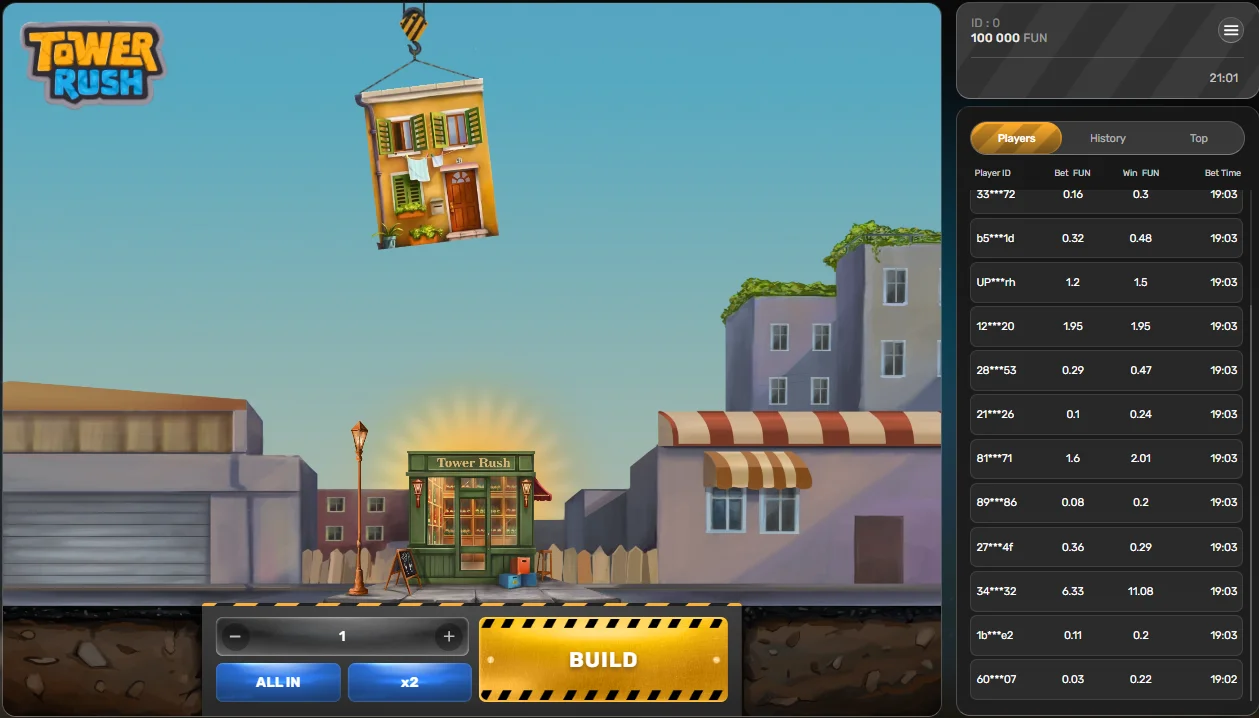
Tower Rush is a thrilling crash game where players can bet and watch the multiplier rise. The goal is to cash out before the tower collapses, making each round an exciting challenge.
In summary: Tower Rush is an engaging crash game created by Galaxsys. With a medium volatility, players can wager between 0.1 and 100 credits, seeking a maximum win of 100 times their bet. It features an RTP ranging from 96.2% to 97.55%. Try the demo today.
Game Details
- Game type
- Tower Rush
- Developer
- Galaxsys
- Risk level
- Average risk
- RTP
- 96.2–97.55%
- Max payout
- 100x
- Betting range
- 0.1 — 100
- Launch date
- Jun 18, 2026
- Category
- Crash-style game
Unique mechanics
Cashout option
Utilize the auto-cashout feature to set your desired multiplier for an automatic payout.
Multiplier Display
The multiplier display continuously shows how high you can go, adding excitement to your decision-making.
Risk Levels
Choose from different risk levels to match your comfort with potential losses.
Join for real stakesImagine a newcomer opening Tower Rush with zero money involved: no deposit made, no account created, only an empty lot and a pile of practice credits. For anyone curious about Tower Rush, that quiet start is the kindest possible introduction, and this whole page is arranged around it.
First sessions usually prompt a few puzzled thoughts. What is the actual objective? When is a sensible moment to stop? Why did everything tumble just then? None of those puzzles has to be solved with real cash at risk.
The sequence below is intentional. Free practice leads, followed by the screens that can run the game, followed by the written rules carried by each version. After those three, the page moves on to the round itself, the special floors and the handful of published numbers.
Protection fills the last part. Spending caps, session clocks and some frank words about chance belong in any fair introduction to a game that is, at heart, about risk.
Read in order or skip ahead to whatever you need. Either way, real stakes should arrive only once nothing about the game can catch you off guard.
Welcome to the Tower Rush site
Our aim is modest: to explain a single title thoroughly. Tower Rush is brief and quick, and quick games tend to favour people who learn them ahead of time instead of mid-round.
So the game gets dismantled here, one part at a time. You will see how it opens on bare ground, why every extra storey makes the following one shakier, which three special floors exist and what is officially said about each. You will also learn where the return-to-player percentage is printed and why it varies between operators.
Limits get real space too. A crash-format round may last only seconds, so deciding how much you can spare belongs before the opening round rather than after the tenth.
Some things are absent on purpose. Made-up numbers, secret tricks and talk of reliable profit have no place on this page, since outcomes are random and anyone hinting otherwise wants something from you.
Galaxsys, the developer, publishes the core facts quoted throughout. Whenever a detail hinges on which build an operator has chosen, we flag it and point toward what that build itself publishes in its rules instead of filling the gap with guesswork.
Starting with the Tower Rush demo
Practice mode is the obvious opening move. The Tower Rush demo is funded with virtual credits, meaning rounds cost you nothing, and plenty of online casinos carry it, alongside our own page.
Treat it as a chance to absorb the tempo. Observe the multiplier creeping upward as storeys stack, and notice how a collapse can strike at a moment that feels almost rude. Getting used to that sensation is far cheaper here than anywhere else.
Experiment with both exits as well. End some rounds manually, then let a preset target do the job in others. They feel surprisingly different, and practice reveals which one fits your temperament.
A useful discipline is to handle practice credits as though they mattered. Keep one stake size, jot down roughly how each session went, and quit at the point you chose beforehand. Played like this, the demo teaches you about your own habits, not merely about mechanics.
Bear one caveat in mind. Practice credits are worthless outside free play, and a lucky streak there forecasts nothing for a later paid session. Each round is a fresh draw, in either mode.
Phones, tablets and desktop
The game opens inside an ordinary browser, which means installation is never required. A desktop, laptop, tablet or smartphone will all do.
Because of that, be wary of any so-called downloadable edition or app file. Tower Rush needs no download, and unknown installers are a familiar route for malware and for stealing personal data.
Smaller screens call for extra care with Tower Rush. Rounds move quickly, and a careless touch comes easily on a narrow display. If a handset feels cramped, a tablet may give you a calmer view.
Connection quality counts as well. Brief rounds leave little margin for a signal that drops, so a dependable Wi-Fi network or strong mobile data makes sense before staking real money.
Whatever hardware you pick, the rules, the RTP range and the special floors stay identical. Only the size of the picture changes.
Reading the in-game rules
Each build of Tower Rush ships with its own in-game rules, and that text merits a few unhurried minutes before any paid round. Several key details are recorded there and only there.
Begin with return to player. Galaxsys gives a span for the title instead of one fixed percentage, and every operator installs a single build from inside that span. The precise figure for your copy appears in its rules, which explains why two sites might display slightly different numbers.
Volatility comes next. The term captures how outcomes spread across many rounds, ranging from frequent modest outcomes to scarcer bigger ones. No label is offered on this page, because each build's rules name it themselves, and that wording is what counts.
Top multiplier and largest possible win follow the same logic. You will find both in the rules attached to whichever build you have loaded, so verify them there rather than trusting a number quoted on some forum.
Regarding fairness verification, we make no statement either way. Anyone who cares about that point should consult the rules and the operator's documentation.
Two minutes of reading now can spare you a costly assumption later.
The aim of Tower Rush
Galaxsys launched Tower Rush in 2026. It belongs to the crash-style branch of instant games, in which a multiplier grows during a round until something halts it, and you must judge when to step away.
Here the twist is building. Rather than a curve rising across a chart, you raise a tower storey upon storey. Every round opens on an empty plot, and with each added level the multiplier edges higher.
The danger comes bundled with that same action. Every floor you add also makes it likelier that the next one brings the whole structure down. Reward and peril climb in step, and at no stage does the risk drop back.
Completing the tower is therefore not the point, since no completed tower exists. The real objective is to recognise when you have enough, then take what the multiplier currently offers before the structure gives way.
In Tower Rush, the central choice falls to you each round: one more storey, or leave with what is already there.
Building, cashing out, collapsing
Any round can be told in three chapters, although you only ever live through two.
Construction opens it. Your stake goes in on bare ground, and storeys start appearing. With each one, the multiplier applied to your stake grows.
After that, one of two endings arrives.
In the first, you cash out. Right up to a collapse, leaving is allowed, collecting your stake multiplied by whatever figure the multiplier holds right then. Your result is settled, and the round is finished for you.
In the second, the tower gives way. Should the building fall while you remain inside the round, your stake for it disappears. Floors already raised give nothing back, unless a special floor locked in part of the winnings, as explained further on.
To put numbers on it, imagine you stake 1.20 CAD and leave once the multiplier shows x6. Your return is 7.20 CAD. Treat that strictly as a worked example of the calculation: no specific floor is worth x6, and no round is guaranteed to get that far.
The example also hints at the tension. Exit sooner and you collect less. Hold on and the payout grows, though only if your building is upright when you make the call.
Nothing announces an approaching collapse. A tower might survive many storeys or fold within moments, and whatever happened last round has no bearing on this one.
That is the loop in full: build, decide, and live with whichever ending comes first.
Auto cash-out settings in Tower Rush
Not everyone enjoys choosing an exit with adrenaline running. Auto cash-out answers that need.
Before any floor goes up, you choose the multiplier at which you want out. Should the tower reach it, the game settles your round automatically. Should the tower fall sooner, you lose that stake just as you would otherwise.
Its main virtue is steadiness, which suits a game as quick as Tower Rush. A preset figure removes the urge to linger for just one extra storey when instinct pleads for it, turning a jittery moment into a rule you wrote while composed.
Compromise is unavoidable. Ambitious targets pay more yet come up less often; modest ones pay less yet arrive sooner. Neither tilts long-run odds, since rounds are independent and random.
Test several targets in Tower Rush free play before using real funds. Note how frequently each is reached and how your balance drifts across a session. That first-hand sense beats any formula printed here.
Special floors you may meet
Some storeys of a Tower Rush tower break the usual pattern, and they tend to be the part newcomers ask about most. Midway through a round, any one of a trio of special floors can surface, and each alters the round in its own fashion.
| Floor | Effect |
|---|---|
| Frozen Floor | Secures whatever winnings stand at that level |
| Temple Floor | Has its own multiplier behaviour, altering how the multiplier moves |
| Triple Build | Has a multiplier behaviour of its own, changing the way the multiplier moves |
Of the three, Frozen Floor is easiest to grasp. When it lands, the sum built up by that level becomes safe. Picture a safety net: whatever befalls the tower later, that locked sum stays yours.
Temple Floor and Triple Build, by contrast, take another route. Instead of guarding an amount, they reshape how the multiplier travels through the round. Galaxsys characterises both as having their own multiplier behaviour, and exact mechanics are documented build by build in the rules.
No values are given for any of them here, by choice. A number would only be speculation, and speculation about bonus features spreads fast and misleads plenty of people. For specifics, the rules of your loaded build are the authority.
Knowing what these floors are not matters too. No player can summon them, and seeing one in a round predicts nothing for the next. A long stretch without any does not make one overdue.
The healthiest attitude treats them as welcome variety inside a game of chance. Enjoy them when they appear, but never raise your stake or chase extra rounds hoping one will turn up.
RTP and stake limits in Tower Rush
Only a few figures are published for Tower Rush, and every one of them carries a condition.
Return to player: Galaxsys states a span whose low end is 96.2% and whose high end is 97.55%. Where a given operator lands inside it depends on the build installed, and the exact percentage is shown in that build's rules. What RTP really means: a theoretical average computed over a huge quantity of rounds. It forecasts nothing about one evening of play, and it never promises that part of your money comes back. Lowest stake: 0.10 CAD, subject to how the operator has set things up. Highest stake: 100 CAD per round, again depending on operator settings. Differences between sites: one operator may allow a narrower band than another, so confirm the range wherever you log in. Volatility: named build by build in the in-game rules, with no universal label. Top multiplier and largest win: likewise listed in each build's rules. Look them up for the copy you are using, not on a third-party page. Stake versus budget: a wide range lets you size stakes to your means. Small stakes stretch a session; large ones can drain it within a few rounds.
None of this alters the basic reality. Every round is settled at random, and even a higher-RTP build will produce losing sessions.
Moving from demo to real stakes
When free play feels familiar, switching to paid rounds is a practical step with strict conditions attached.
Paid Tower Rush play happens exclusively at licensed operators whose lobbies include Galaxsys titles. Galaxsys builds the game; the operator keeps your account, accepts deposits and pays withdrawals. Those roles are separate, and the licence relevant to you as a player is the operator's.
Only adults may play for money. You need to be 18 or above, and it is wise to check that online gambling is lawful where you reside.
When picking an operator, look for a valid licence shown openly. Then compare the stake band it applies, since that varies. Expect identity checks before any withdrawal, and once registered, browse the instant or crash category to locate the game.
Approach promotions cautiously. Every operator writes its own terms, which can cover how much this type of game contributes toward wagering, which games do not count at all, plus a cap on bet size while a promotion is running. Read them before accepting.
Avoid unlicensed sites, tip channels and any so-called predictor on sale. Nothing can anticipate a random collapse, and whoever charges for such a tool is exploiting hope.
Budget and time limits for Tower Rush
Short rounds make it easy to play many more than planned. A handful of habits keep things proportionate.
Settle on a budget first. Pick a sum you could lose completely without hardship, and regard it as the cost of entertainment, never as an investment. Choose a session length too. A clock often beats a balance, because rapid rounds merge together and minutes vanish. Scale stakes to that budget. A small stake relative to the total buys more rounds and fewer abrupt swings. Agree with yourself on a loss cap and a stopping point for good runs. Quitting while ahead is also a decision, and a far easier one when made early. Switch on operator tools. Caps on deposits and reminders about time can be applied to your account, and they hold even when willpower wobbles. Pause regularly. A few minutes away refreshes judgement and makes impulsive choices less likely. Never pursue losses. Upping stakes to recover money already gone is how a poor session becomes a far worse one. Heed the warning signs. If gambling no longer feels enjoyable, or it has become a way to escape trouble, look into self-exclusion and get in touch with a professional help service for gamblers. Before the first real round
A brief list of candid points to revisit before you commit actual money.
RTP depends on which build is installed. Your figure is the one printed in that build's rules, no lower than 96.2% and no higher than 97.55%. A collapse costs you that round's stake. Unless a special floor has already secured some winnings, nothing from the round is returned. Largest win and volatility have to be checked in the rules. They are not universal, and this page does not quote them. Rounds are independent and random. Earlier collapses, long towers and short ones carry no information about the next. No approach guarantees a win. Preset targets, staking patterns and timing habits shape how you play, yet none defeats chance. Paid play is for those aged 18 or more, and only at licensed operators.
RTP overview
This calculator derives its figures from the game's RTP and a fixed bet amount. It produces an average outcome over time, not a guarantee for your play. RTP 96.2%
- Total bets placed
- 5,000
- Projected return
- 4,810
- Typical outcome
- -190
This is a theoretical estimate; actual gaming experiences can vary, and there is a risk of losing your entire wager.
Try it free
Explore the game using practice funds — no need to register or make any initial payment.
Comparative Analysis
| Game type | Developer | RTP | Max payout | Risk level |
|---|---|---|---|---|
| Tower Rush | Galaxsys | 96.2–97.55% | 100x | Average risk |
| Aviator | Spribe | 97% | Unrestricted | High risk |
| JetX | SmartSoft Gaming | 97% | Unrestricted | High risk |
| Plinko | Spribe | 97% | 1,000x | Changed |
Common questions
Do demo credits carry over to real play?
No. The demo uses virtual credits, and those credits exist solely inside free play, holding no cash value.
Can I play Tower Rush without installing anything?
Yes, a browser on your phone, tablet or computer is enough. Should any site insist on a separate installer for Tower Rush, close it, since the genuine title never needs one.
Is there a strategy that always works?
No. Collapses happen at random, so no pattern, system or paid tool can tell you when to leave. A plan can govern your spending, which is a different and far more realistic aim.
What happens to my stake if the tower falls?
You forfeit the stake placed on that round. The one exception is when Frozen Floor locked in winnings at an earlier level, something your build's rules describe.
Who makes Tower Rush?
Galaxsys develops it. The studio supplies it to operators, and they run player accounts, process payments and hold the licence covering your play.
Can I change the auto cash-out target between rounds?
The target is set in advance of the round, so fix it before construction begins.
Need support?
Free and private support is available when gaming is no longer enjoyable.
For players aged 18 and above. Gamble responsibly. Be aware of the risks — only bet what you can afford.
Are you ready to take on the Tower Rush challenge?
Play smart. This game allows practice without money involved. Only for ages 18 and above. Check your jurisdiction for any gambling laws.
Start your practice session